Reference build · Evidence-first document AI
Document extraction where every retained value points back to the source.
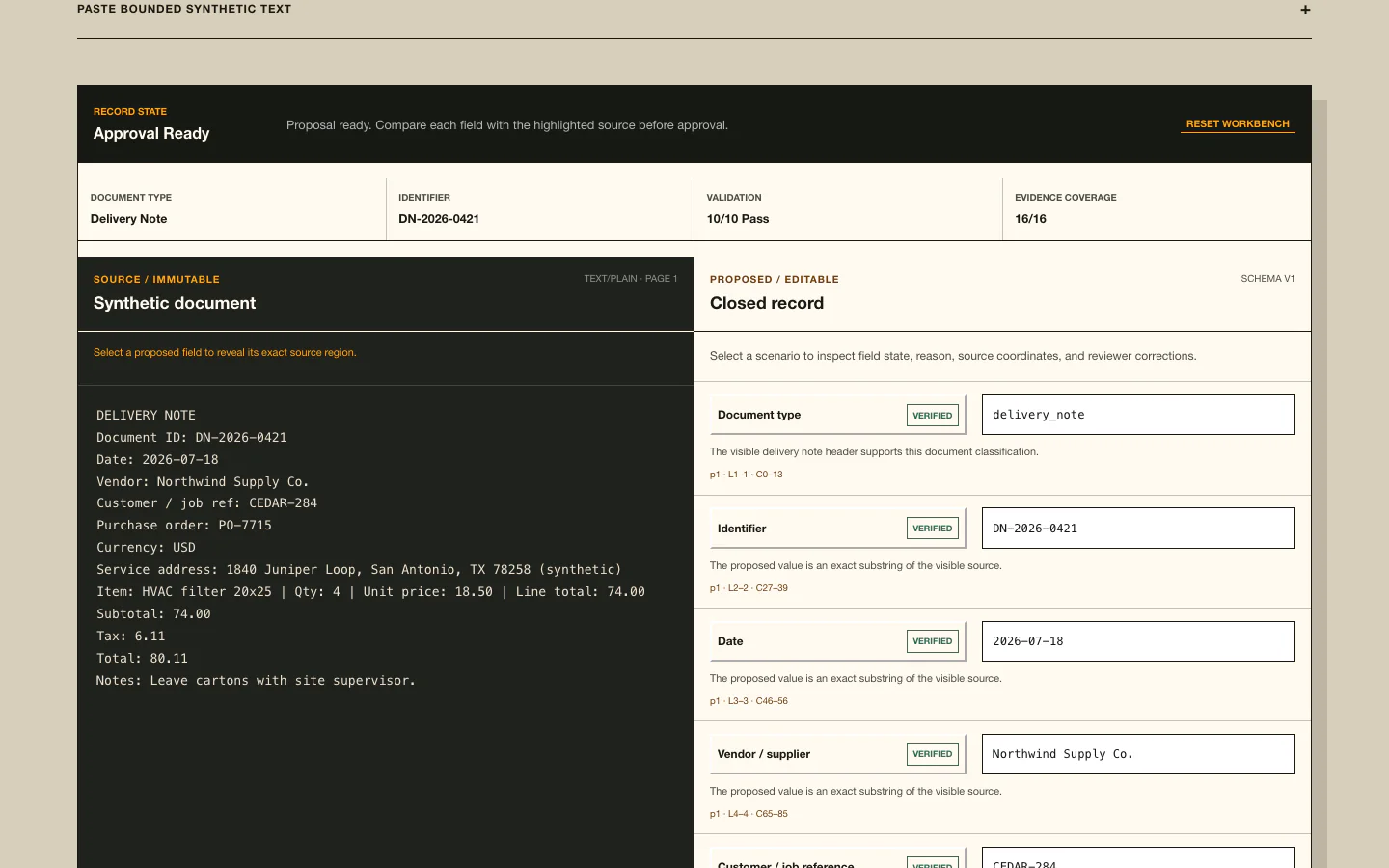
A working reference for extracting delivery notes and work orders into a closed schema while preserving exact evidence, deterministic checks, and human approval before export.
- Proof type
- Reference build
- Audience
- Agencies and operations teams evaluating document workflows
- Timeline
- Reference build reviewed in July 2026; no client rollout or processing-volume result is claimed.
- Last reviewed
01 / Buyer and problem
The system had one clear job—and explicit limits.
Document models can return plausible fields that are absent, ambiguous, or inconsistent with the source. A usable workflow needs to preserve the original, remove unsupported values, surface deterministic conflicts, and block export until review.
Who this helps
The reference is designed for document processes where a proposed value must remain traceable to the original and a person owns final approval.
Exact role
Designed and implemented as a working reference build, including the Astro review interface, same-origin API contract, closed-schema extraction, server-side evidence validation, deterministic checks, local fallback, and tests.
Constraints
- Treat the document as untrusted input and never follow instructions embedded inside it.
- Require each populated field to retain an exact source excerpt; clear values that cannot be located.
- Validate one closed schema, cap input at 8,000 characters, and keep API credentials server-side.
- Keep line items in review and block approved export until the person compares the proposal with the source.
Scope
- Delivery-note and work-order intake
- Closed-schema model output
- Exact-substring evidence validation
- Deterministic totals and duplicate checks
- Hostile-instruction handling
- Human review and reviewed JSON export
02 / Architecture
A visible path from input to controlled result.
- 01
Bounded intake
Same-origin, content-type, length, rate, and consent checks guard the request.
- 02
Closed extraction
The model can propose only the declared document, field, line-item, warning, and summary structure.
- 03
Evidence post-validator
Unsupported values are cleared instead of being completed by inference.
- 04
Deterministic rules
Totals, duplicates, type conflicts, and injection-like content are handled outside the model.
- 05
Human-controlled export
Reviewed JSON stays locked until every retained value keeps evidence and the person confirms comparison.
03 / Delivery process
The work, in the order it became verifiable.
- 01
Confirm bounded processing
The person removes unnecessary sensitive data, confirms one-time processing, and submits a length-limited document.
- 02
Extract to one schema
The server treats the document as untrusted content and requests a constrained structured proposal.
- 03
Validate exact evidence
A post-validator clears populated values that cannot point to a literal excerpt in the submitted source.
- 04
Apply deterministic checks
Totals, currency conflicts, duplicate input, document type, and hostile instructions produce visible rules-based warnings.
- 05
Review before export
The person compares and corrects the proposal; unsupported edits remove evidence and keep approval locked.
04 / Decisions and tradeoffs
The useful part is why the boundary exists.
Treat model output as a proposal
A structured response is not evidence that a value exists in the source.
- Tradeoff
- The workflow requires review and may clear fields a person could otherwise infer.
Keep validation deterministic where rules are available
Arithmetic, exact evidence, type headers, and duplicates can be inspected without another model judgment.
- Tradeoff
- Rules must be maintained as supported document formats evolve.
Require explicit processing consent in the reference
The interface makes the external processing boundary visible before text reaches the project API.
- Tradeoff
- The extra step adds friction and is not a substitute for a complete production privacy review.
05 / Evidence
What can be inspected—and what cannot be claimed.
- Input boundary
- 8,000 characters
The interface and project API document the maximum submitted text length.
- Prepared tests
- 3 document scenarios
The public reference includes a clean note, an ambiguous work order, and a hostile-instruction sample.
- Evidence contract
- Exact source excerpt
A populated field without matching literal evidence is cleared or returned to review.
- Commercial result
- Not claimed
No accuracy rate, processing-time reduction, cost saving, document volume, or client outcome is presented.
06 / Outcome and handoff
A working document-review reference that keeps source text, proposed fields, exact evidence, warnings, corrections, and approval in one inspectable flow.
Services connected to this work
Technologies used
- Astro
- TypeScript
- Node.js
- OpenAI API
- Zod
- Deterministic validation
- Playwright
Evaluating document automation?
Start with the evidence and approval contract.
Bring one de-identified document shape, the fields that matter, and the errors a reviewer must be able to catch.
Book a 20-minute fit call